Adjudicating over Anarchy: Judicial Remedies, Compliance, and Enforcement in International Law
26 May 2026
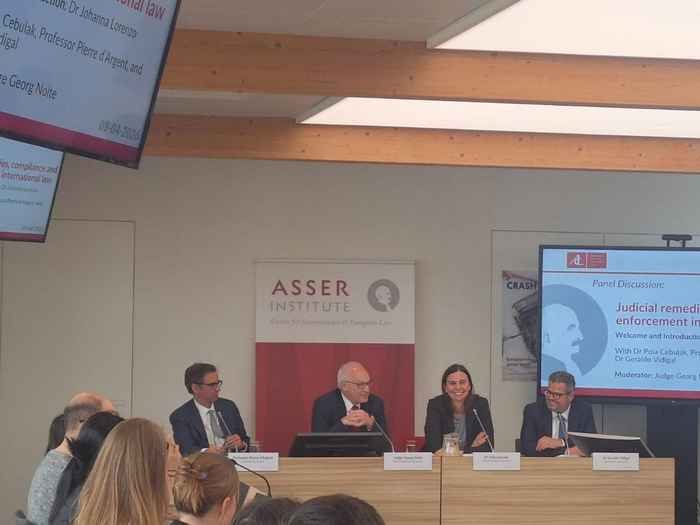
The book has already been the subject of discussions and presentations at several leading institutions, including the T.M.C. Asser Institute (pictured), the Oxford Public International Law Research Group, the Harvard Journal of International Law, the Fletcher School of Law and Diplomacy, the New York Law School, as well as before the American Society of International Law (Interest Group on International Courts and Tribunals).
The book addresses a central question of international legal scholarship: how can international courts produce tangible results when they lack direct access to coercive enforcement mechanisms in the form of state force to support their rulings? Drawing on both international legal and international relations scholarship, Dr. Vidigal develops a comprehensive theory of international judicial authority, examining how judicial decisions shape expectations, mobilise compliance, and affect real-world outcomes despite operating in a decentralised international legal order.
Building on this theoretical framework, the book analyses the ways in which international courts deploy judicial remedies to induce compliance with international law. It explores how courts interpret obligations, declare violations, determine reparations, and, in certain contexts, authorise responses to unlawful conduct. Through an extensive examination of more than a century of judicial practice across areas including territorial and maritime disputes, human rights, trade, and investment law, the book demonstrates how international courts have increasingly developed procedural and remedial mechanisms aimed at strengthening compliance and enforcement.
Published as part of the Cambridge Studies in International and Comparative Law series, the monograph brings together theoretical reflection and detailed doctrinal analysis to offer a significant contribution to contemporary debates on international adjudication, judicial authority, and the effectiveness of international law.